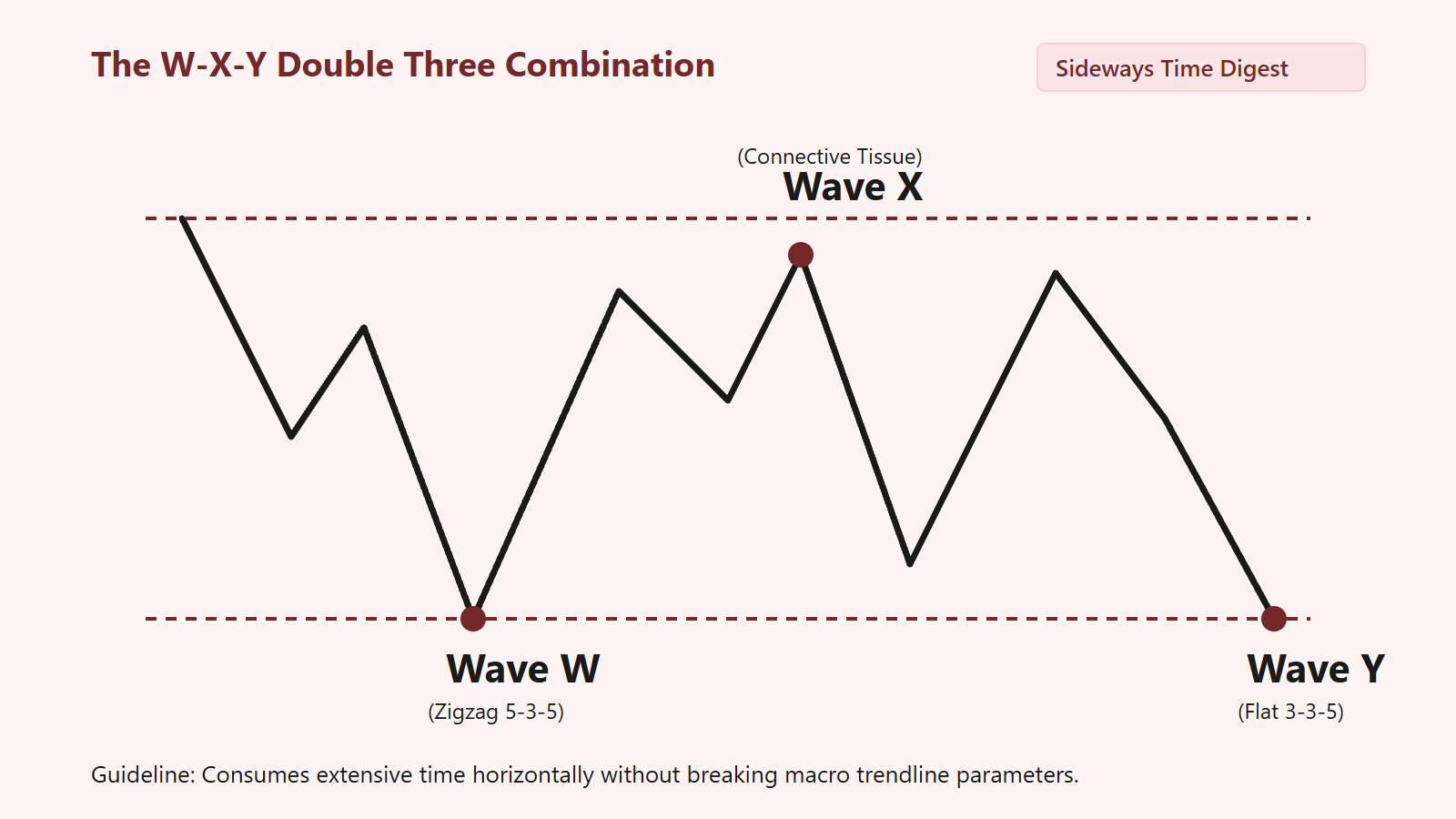
In a perfectly mathematical environment, all market pullbacks would unfold as simple, elegant Zigzags or Flats. However, mass psychology is frequently indecisive. When a market needs to consume significant time without giving up much price territory, it strings simple corrections together into complex geometric combinations. I label these structures as W-X-Y (Double Threes) and W-X-Y-X-Z (Triple Threes). The most critical element I look for when mapping these environments is the X wave—the connective tissue that binds standard corrective patterns into a larger fractal chain.
The Functional Purpose of Corrective Combinations
When an impulsive motive phase concludes, the market enters a corrective regime designed to rebalance structural extremes. In aggressive trending environments where underlying momentum remains overwhelmingly potent, the market refuses to execute a deep vertical retracement. If buyers or sellers aggressively defend intermediate price thresholds, the corrective energy cannot discharge vertically through price distance. Instead, it must discharge horizontally through time.
This is the fundamental reason complex combinations exist. A single corrective pattern—such as an isolated 5-3-5 Zigzag or a 3-3-5 Flat—often concludes too quickly to allow the broader market degree to absorb prior structural excess. To resolve this imbalance, mass psychology enters a state of rotational consolidation. The market completes one simple corrective structure, pauses in an intervening counter-swing, and immediately begins an entirely new corrective structure in the original corrective direction.
By chaining these sub-structures together, the market creates an expansive sideways channel. In my structural tracking, recognizing when a simple correction is morphing into a complex combination is one of the most vital distinctions an analyst can make, saving immense capital and preventing false assumptions regarding trend resumption.
Deconstructing the Double Three (W-X-Y) Architecture
A Double Three is a compound corrective structure consisting of three distinct sub-phases labeled sequentially as Wave W, Wave X, and Wave Y. Unlike standard impulse waves that subdivide into five waves, every component of a combination is inherently “three-wave” in nature, creating a 3-3-3 internal framework.
Let us dissect the structural anatomy of each phase:
- Wave W (The First Corrective Leg): Wave W is never an impulse wave. It must unfold as a complete standalone corrective pattern. Typically, Wave W manifests as a standard Zigzag (5-3-5), an Expanded Flat (3-3-5), or occasionally a running structure. It establishes the initial boundary of the consolidation range.
- Wave X (The Connective Tissue): Once Wave W terminates, the market initiates a counter-move in the direction of the macro trend. This is Wave X. It is designed to trap aggressive participants who prematurely believe the correction is complete. Wave X can take the form of any corrective structure (most commonly a zigzag or complex flat), but its primary mathematical characteristic is that it connects Wave W to Wave Y without exceeding the structural origin of Wave W.
- Wave Y (The Secondary Corrective Leg): After Wave X exhausts its momentum, Wave Y unfolds in the direction of Wave W. Wave Y is also a complete corrective pattern. Crucially, Wave Y almost always alternates in character from Wave W. If Wave W was a sharp Zigzag, Wave Y will frequently unfold as a sideways Flat or a Contracting Triangle.
Mathematically, I observe that Wave Y frequently relates to Wave W through strict Fibonacci proportions. In a standard Double Three, the vertical length of Wave Y often equals 100% of Wave W (Y = W), or reaches the 0.618 or 1.236 extension of Wave W projected from the termination of Wave X.
The Enigma of the Triple Three (W-X-Y-X-Z)
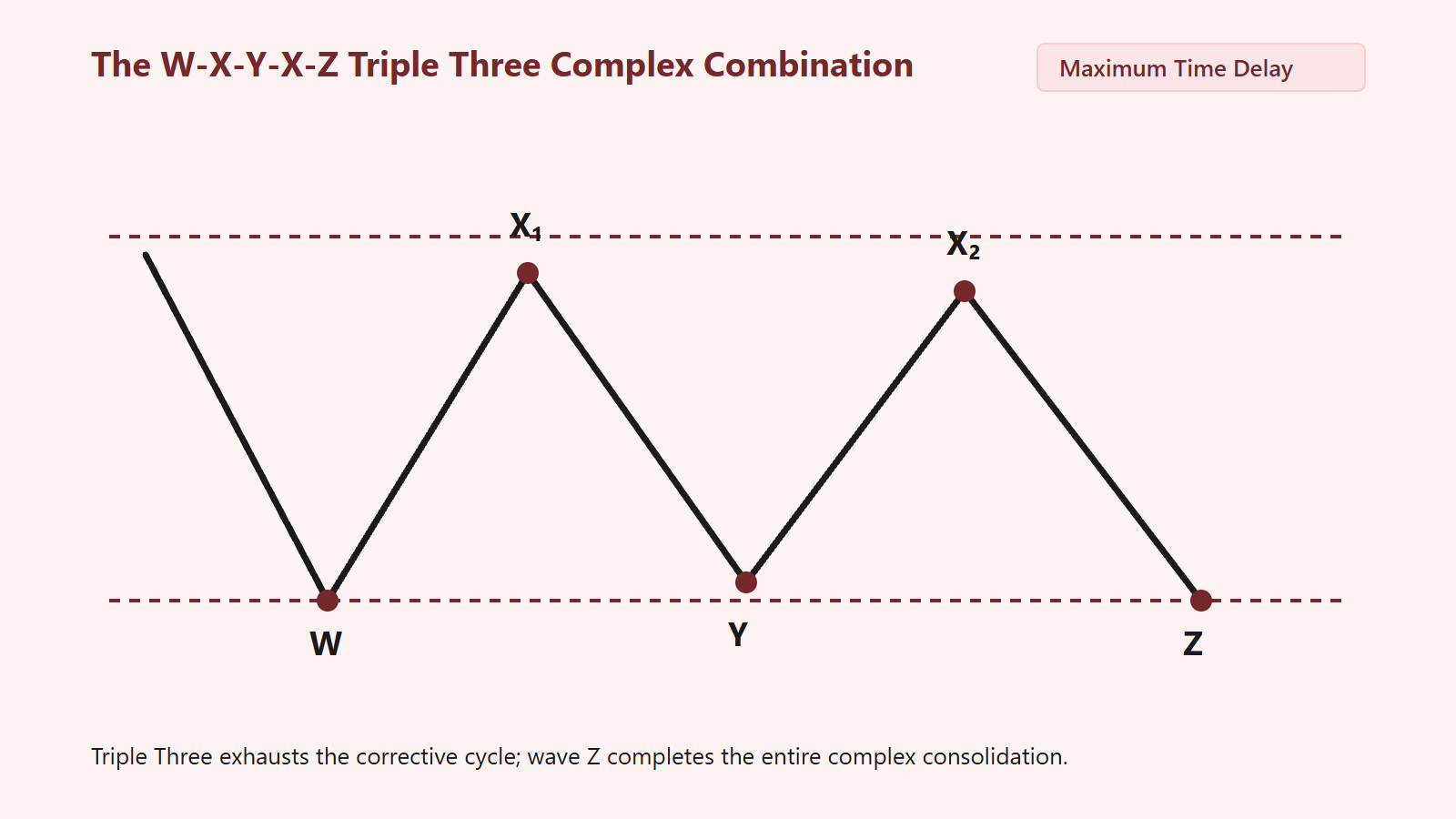
While Double Threes are common across both micro and macro degrees, mass psychology occasionally requires an even greater duration of temporal absorption. In these rare, exhaustive environments, the market constructs a Triple Three, labeled W-X-Y-X-Z.
A Triple Three represents the absolute mathematical limit of corrective complexity under the Elliott Wave Principle. Just as an impulse wave cannot exceed five sub-waves, a corrective combination cannot exceed three distinct primary corrective units linked by two intervening X waves. The sequence unfolds as follows: Corrective Pattern W → Link X1 → Corrective Pattern Y → Link X2 → Corrective Pattern Z.
In my analytical observations, Triple Threes possess unique structural hallmarks:
- Extreme Horizontal Compression: Triple Threes almost never display significant slope or vertical angle. They drift horizontally inside tightly bound parallel regression channels.
- Terminal Triangles in Wave Z: The final leg, Wave Z, very frequently resolves as a Contracting Triangle (3-3-3-3-3). When a triangle appears as Wave Z of a combination, it signals the definitive exhaustion of the entire multi-phase consolidation, preparing the market for an explosive breakout.
- Diminishing Volatility: As the pattern progresses from W to Y to Z, volume and structural amplitude systematically decay, mirroring the psychological depletion of market participants trapped inside the multi-month chop.
The Rule of Alternation Inside Combinations
R.N. Elliott’s Guideline of Alternation is not confined solely to motive waves (such as the alternation between Wave 2 and Wave 4). It operates with absolute elegance inside complex corrective combinations. In my modeling, I rely heavily on alternation to anticipate the exact structural form that Wave Y or Wave Z will adopt.
The core principle of corrective alternation dictates that consecutive corrective patterns within a single combination will rarely mirror each other’s geometric personality. If Wave W is characterized by sharp vertical displacement, high velocity, and unfolds as a 5-3-5 Zigzag, it is mathematically improbable that Wave Y will also unfold as a simple Zigzag. Instead, Wave Y will almost certainly manifest as a flat, an expanded flat, or a triangle to provide structural contrast.
Furthermore, combinations frequently display alternation between directional angle and sideways distribution:
- Zigzag + Triangle (Double Three): The market rapidly retraces price in Wave W via a zigzag, stabilizes horizontally in Wave X, and then churns through five contracting sub-swings in a Wave Y triangle, consuming maximum time before the trend resumes.
- Flat + Zigzag: Wave W churns sideways in a 3-3-5 flat structure, followed by an intervening Wave X rally, and concludes with a decisive 5-3-5 zigzag in Wave Y to quickly test key structural support levels.
Analytical Guidelines for Validating Complex Corrections
To avoid mislabeling standard impulses or simple corrections as complex combinations, I adhere strictly to several non-negotiable structural rules:
- Subdivisions Must Be Non-Impulsive: Every primary leg (W, Y, Z) and every connector (X) must cleanly subdivide into 3-wave internal structures (or 5-wave contracting structures in the case of triangles). An impulse wave (5-wave structure) can never appear as an entire W, X, Y, or Z leg; impulses can only exist as internal sub-waves (such as wave A or C of an internal zigzag).
- Channeling Symmetry: True combinations fit remarkably well inside parallel boundary lines. Drawing a trendline connecting the extremes of W and Y, and projecting a parallel line through the peak of X, establishes the terminal target zone for Wave Z or the conclusion of the pattern.
- Fibonacci Wave Relationships: Always calculate the equality ratio: $Y = W$. If $Y$ extends beyond $1.618 imes W$, the structure is likely not a combination but an entirely different impulsive cycle unfolding in the opposite direction.
Navigating sideways combinations requires an analytical mindset centered on patience and geometric discipline. When you stop anticipating immediate vertical trends and learn to appreciate the mathematical rhythm of W-X-Y and W-X-Y-X-Z combinations, the most frustrating consolidating markets transform into masterclasses of structural predictability.

Leave a Reply