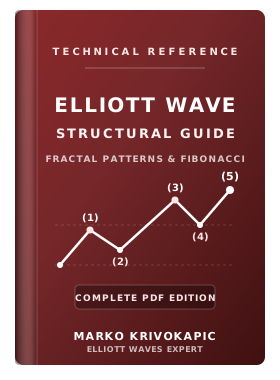
The Elliott Wave Structural Reference Guide
Master structural price geometry, invariant wave constraints, and Fibonacci proportions in one comprehensive technical manual.
As an independent quantitative researcher and Elliott Wave specialist, I developed this reference manual to provide an objective mathematical blueprint for cycle analysis. Gain instant access to standardized wave invariants, corrective taxonomies, and multi-timeframe projection rules.
1. Motive Wave Rules & Invariant Constraints
Structural anatomy of motivating trend sequences (1-2-3-4-5). Covers the cardinal laws that govern wave integrity: Wave 2 never retraces more than 100% of Wave 1, Wave 3 is never the shortest among motive waves, and Wave 4 never overlaps the price territory of Wave 1 in standard impulse structures.
- Sub-wave motive division benchmarks
- Impulse vs. Leading/Ending Diagonal geometry
- Wave extension characteristics and recognition
2. Corrective Formations & Geometric Classification
Taxonomy of counter-trend consolidation structures. Detailed geometric blueprints for sharp rebalancings and sideways consolidations, including internal sub-wave requirements and terminal coordinates.
- Zigzags (5-3-5) and double zigzags
- Flats: regular, expanded, and running variations (3-3-5)
- Contracting, barrier, and expanding triangles (3-3-3-3-3)
3. Fibonacci Summation Ratios & Projections
The mathematical bedrock of Elliott Wave theory. Complete matrix of golden ratio relationships derived from the Fibonacci sequence to measure retracements, projections, and degree alternations.
- High-probability corrective retracements (38.2%, 50%, 61.8%, 78.6%)
- Impulse wave expansion targets (161.8%, 200%, 261.8%, 423.6%)
- Multi-degree Fibonacci confluence mapping
4. Degree Labeling & Multi-Timeframe Fractal Mapping
Standardized notations for mapping structural cycles without confusion. Learn the precise nesting hierarchy from macro cycle scales down to micro structure.
- Hierarchical degrees: Grand Supercycle through Subminuette
- Parent-child sub-wave nesting conventions
- Multi-timeframe fractal alignment techniques
5. Objective Invalidation Thresholds & Alternation Laws
The cornerstone of disciplined wave analysis: determining where a specific count is mathematically invalidated. Discover how to define hard invalidation price coordinates and apply the Rule of Alternation between consecutive corrective structures.
- Definitive structural pivot coordinates for count invalidation
- Alternation between Wave 2 and Wave 4 depth and complexity
- Managing primary vs. alternate counts without cognitive bias

Get Your Free Reference Guide (PDF)
The complete 5-module technical blueprint delivered directly to your inbox.
Join researchers and chart analysts studying objective price geometry, invalidation rules, and Fibonacci mathematics.