The Elliott Wave Principle is celebrated for its flexibility in modeling complex human psychology, but that flexibility is bounded by strict, immutable laws of structural placement. Nowhere is this precision more evident than in the governance of triangles. A triangle cannot appear randomly across a price chart. It is governed by a universal law of structural mechanics known as the Penultimate Rule. In my analytical practice, verifying the placement of a triangle is the ultimate test of wave count validity. If an analyst places a triangle in an unauthorized wave position, the entire count collapses under mathematical scrutiny. Understanding precisely where triangles are permitted—and where they are forbidden—is the hallmark of professional wave mapping.
The Foundational Law of Penultimate Placement
In market geometry, triangles serve a unique functional purpose: they are terminal consolidation mechanisms. They occur exclusively when the primary trend has exhausted its early kinetic velocity and needs to pause, digest prior gains, and compress volatility before unleashing its final motive leg.
This functional purpose dictates their structural placement. Under the laws of Elliott Wave mechanics, a triangle can only appear in the position prior to the final actionary wave of a pattern of one larger degree. This is known as the Penultimate Rule.
A triangle is never an initial wave; it is never a middle wave of an expanding trend. It is always the penultimate (next-to-last) phase of a larger structure. When you see a triangle form, you know with absolute geometric certainty that the prevailing trend has only one remaining actionary leg before a major structural reversal occurs.
The Permitted Structural Placements
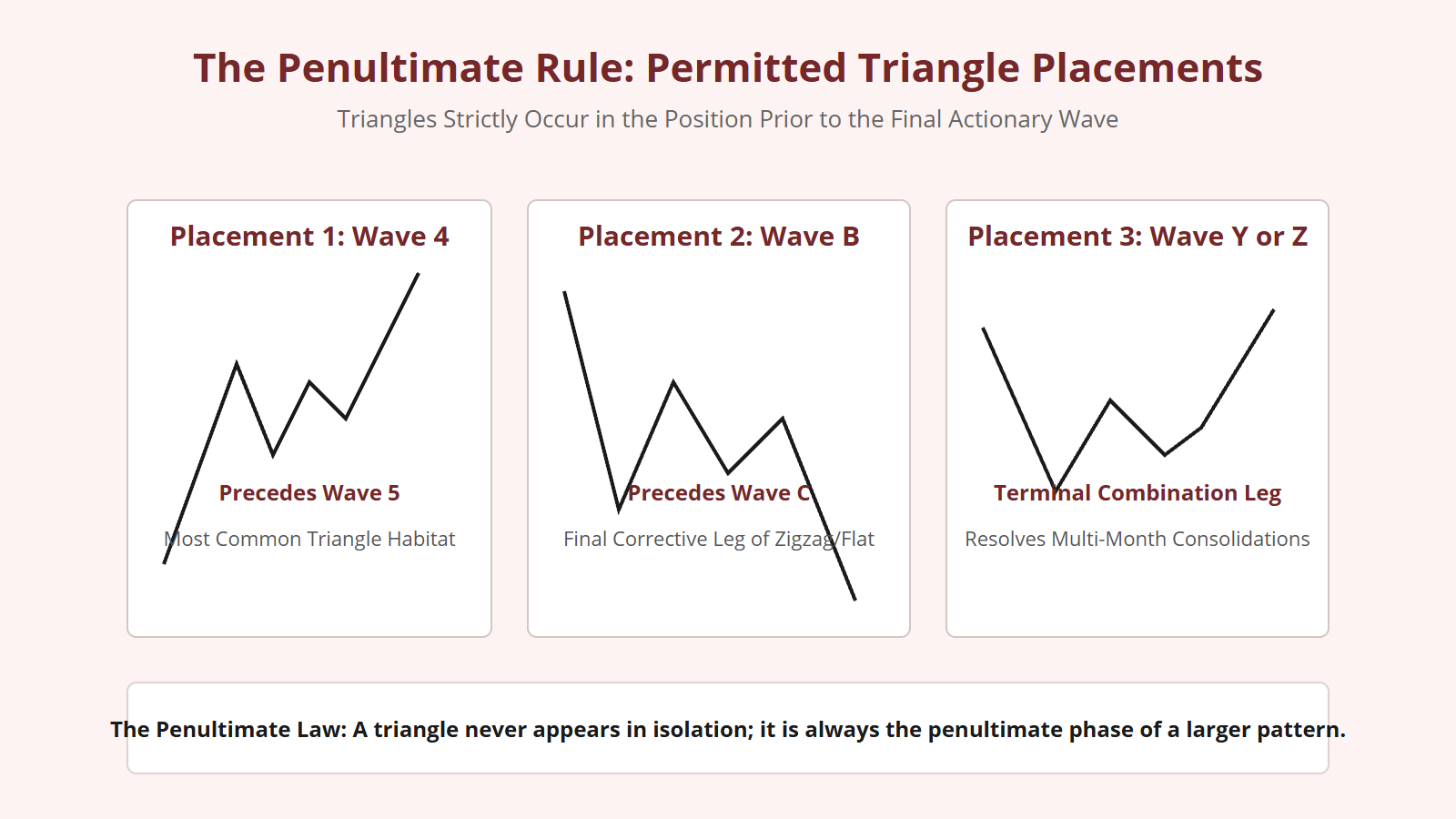
Under the strict rules of wave mechanics, a standalone triangle (Contracting, Expanding, or Barrier) is permitted in exactly three structural locations:
- 1. Wave 4 of an Impulse Sequence: This is by far the most common placement for a triangle (occurring roughly 60% of the time). In accordance with the Guideline of Alternation, if Wave 2 was a sharp, vertical zigzag, Wave 4 almost universally unfolds as a complex sideways structure, frequently taking the form of a contracting or barrier triangle. The ensuing breakout is Wave 5—the terminal wave of the motive impulse.
- 2. Wave B of an A-B-C Correction: A triangle frequently develops as Wave B of a larger corrective pattern (such as an A-B-C zigzag or flat). Wave A establishes the initial counter-trend move; Wave B coils into a 5-wave triangle (A-B-C-D-E); and the subsequent thrust is Wave C—the final wave of the correction.
- 3. Wave Y or Wave Z in a Combination: In complex corrective combinations (Double Threes or Triple Threes), a triangle very frequently occupies the final leg: Wave Y of a W-X-Y, or Wave Z of a W-X-Y-X-Z. When a triangle appears as the final leg of a combination, it marks the definitive conclusion of the entire multi-month sideways consolidation.
Additionally, a triangle can occasionally appear as the final Wave X of a complex combination, directly preceding the final corrective leg.
The Forbidden Placements: Cardinal Invalidation Rules
Just as the Elliott Wave Principle strictly defines where triangles are permitted, it strictly forbids them in other wave positions. Memorizing these forbidden placements is essential for catching invalid wave counts:
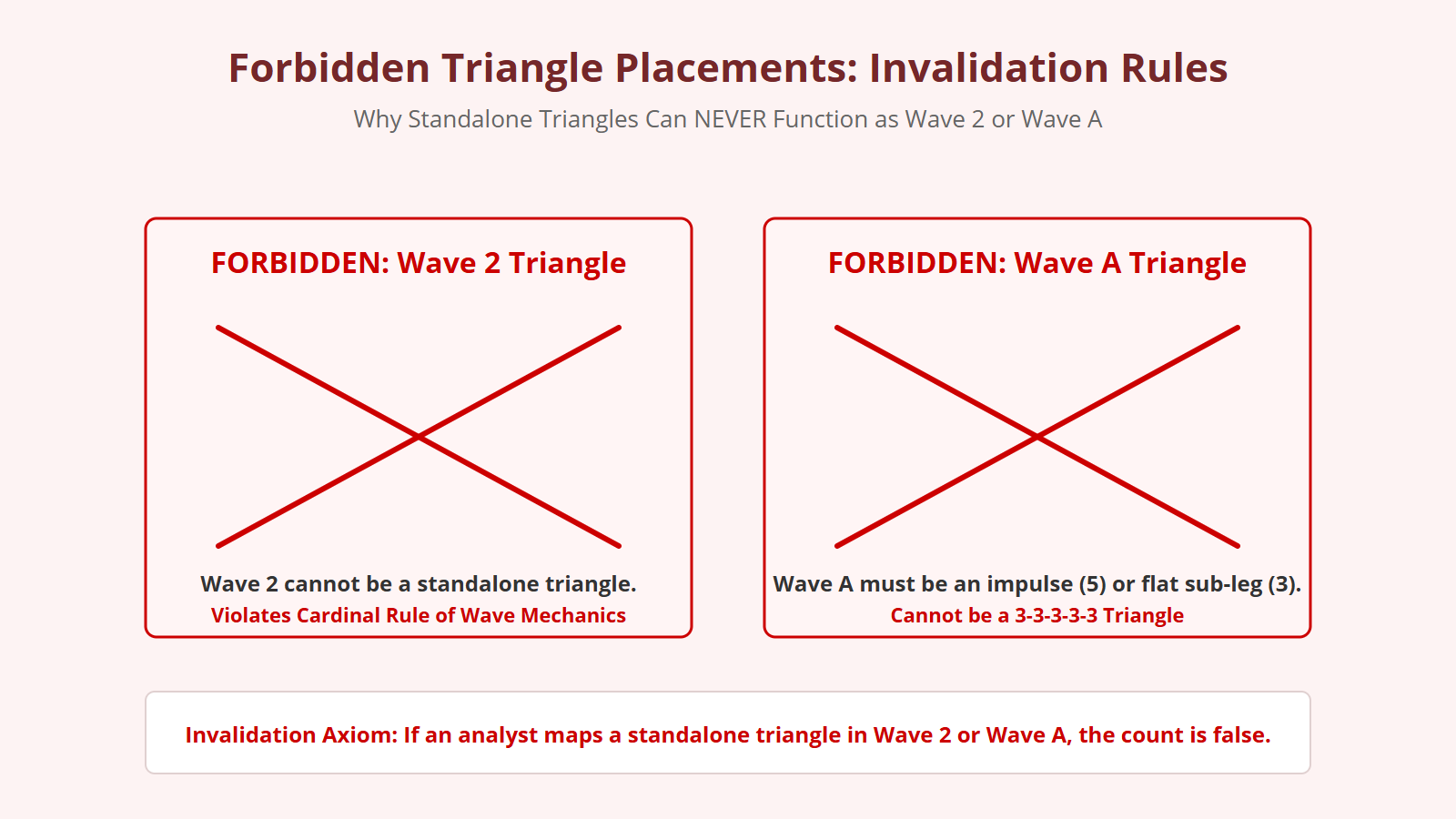
FORBIDDEN PLACEMENT 2: A standalone Triangle can NEVER be Wave A of a standard Zigzag correction.
FORBIDDEN PLACEMENT 3: A Triangle can NEVER be Wave 1, Wave 3, or Wave 5 of an impulse.
Why is a triangle forbidden in Wave 2? Because Wave 2 is a foundational re-test of a nascent trend; it requires a deep, decisive non-impulsive retracement (such as a zigzag or flat) to clear weak hands. A triangle in Wave 2 would leave the trend un-tested and would violate the Penultimate Rule, as Wave 2 is not the next-to-last wave of an impulse (Wave 4 is).
Similarly, Wave A of a zigzag must be a 5-wave motive impulse to establish directional counter-trend momentum. A 3-3-3-3-3 triangle cannot initiate a zigzag.
If you encounter an analyst labeling a standalone triangle as Wave 2 or Wave A, you can immediately discard their work: their count violates the fundamental laws of market geometry.
The Guideline of Alternation in Triangle Placement
When tracking an active five-wave impulse, the Guideline of Alternation provides a powerful predictive filter for triangle placement. Elliott observed that the market strives for structural diversity between its corrective waves:
- If Wave 2 is a sharp, deep Zigzag (consuming minimal time and covering significant price distance), Wave 4 will tend toward a sideways, complex consolidation (consuming significant time and minimal price distance). This makes Wave 4 the ideal habitat for a Triangle.
- Conversely, in the rare scenario where Wave 2 unfolds as a sideways Flat, Wave 4 will alternate by unfolding as a sharp Zigzag. In this scenario, a Triangle in Wave 4 is highly improbable.
By observing the geometry of Wave 2 early in the trend cycle, I can anticipate whether a triangle should be on my analytical radar when price enters the Wave 4 consolidation phase.
Analytical Checklist: Verifying Triangle Validity
Before confirming that a pattern on your chart is an authentic Elliott Wave triangle, run through this disciplined 4-step checklist:
- Verify the Structural Degree Position: Is the pattern forming in Wave 4, Wave B, or the final leg of a combination (Y/Z)? If not, reject the triangle hypothesis immediately.
- Confirm 5-Wave Subdivision (A-B-C-D-E): Does the structure contain five distinct swings? Are all five swings non-impulsive (3-wave structures)?
- Check Boundary Convergence: Do the boundary lines converge cleanly (Contracting/Barrier) or diverge symmetrically (Expanding)?
- Prepare for the Terminal Thrust: Recognize that once Wave E completes, the market will execute its final actionary thrust before reversing the larger trend.
By adhering strictly to the laws of triangle placement, you eliminate analytical ambiguity and align your charting with the unshakeable mathematical architecture of financial markets.

Leave a Reply