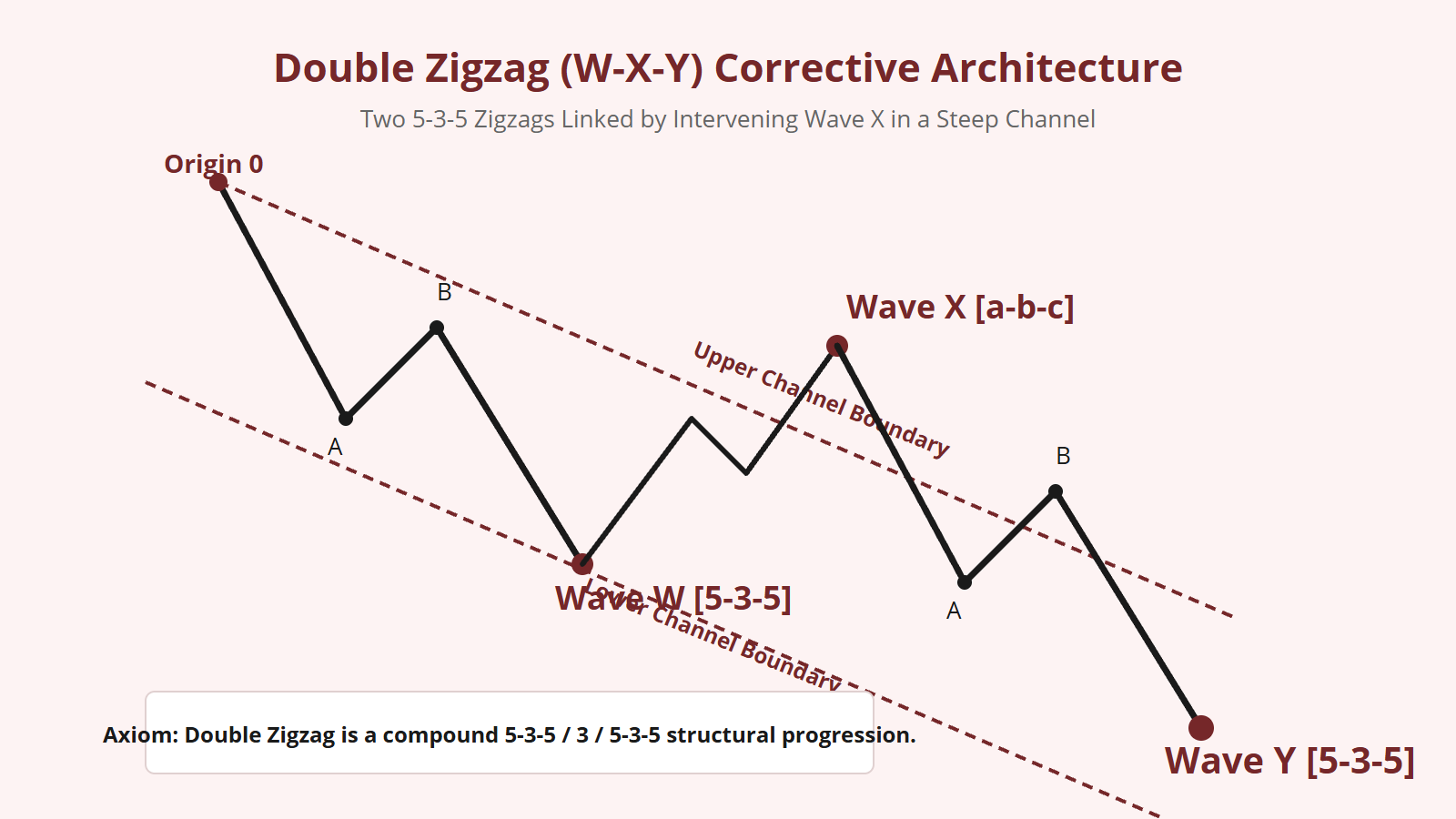
When a standard single zigzag fails to achieve sufficient vertical retracement depth to rebalance an antecedent impulse wave, the market does not surrender its corrective intention. Instead, it chains two independent zigzag structures together into a single, cohesive, aggressive counter-trend sequence. I classify this geometric structure as a Double Zigzag, labeled in modern wave notation as W-X-Y. Unlike complex sideways combinations that consume time horizontally, a Double Zigzag is an aggressive, high-velocity price pattern designed to cover maximum vertical distance in minimum time. Decoding its internal 5-3-5 / 3 / 5-3-5 mechanics is essential for preventing premature counter-trend positioning.
The Functional Purpose of the Double Zigzag
In standard structural mechanics, a single zigzag (A-B-C) is often sufficient to retrace 50% or 61.8% of a preceding wave. However, in environments following an unusually steep or extended motive wave (such as an extended Wave 3 or an aggressive Wave 1), a single zigzag frequently terminates prematurely, reaching only a shallow 23.6% or 38.2% retracement level.
Because the broader market degree requires a deeper geometric reset before the primary trend can resume, mass psychology constructs a secondary zigzag. The market completes the first zigzag (Wave W), bounces in a brief corrective relief rally (Wave X), and immediately initiates a second complete zigzag (Wave Y) in the dominant corrective direction.
In my analytical practice, I never confuse a Double Zigzag with a sideways combination. A Double Zigzag has a steep, aggressive slope. It fits neatly inside a narrow, parallel regression channel and moves with purpose, driving price directly toward key macro Fibonacci retracement targets.
Anatomy and Notation: The W-X-Y Framework
To avoid confusing sub-waves of different degrees, modern Elliotticians utilize the W-X-Y notation for corrective combinations, reserving A-B-C strictly for simple single corrections. The structural breakdown of a Double Zigzag is defined as follows:
- Wave W: A standalone, fully completed 5-3-5 Zigzag. Sub-wave [A] is a 5-wave impulse, sub-wave [B] is a 3-wave counter-move, and sub-wave [C] is a 5-wave impulse. Wave W establishes the initial corrective thrust.
- Wave X: The intervening connective bridge. Wave X is always a 3-wave corrective structure (most commonly a smaller zigzag or flat). Its primary mathematical restriction is that it cannot exceed the price origin of Wave W. In steep double zigzags, Wave X typically retraces only 38.2% to 50% of Wave W, reflecting intense pressure in the corrective direction.
- Wave Y: The secondary 5-3-5 Zigzag. Wave Y unfolds with identical internal geometry to Wave W: a 5-wave sub-wave [A], a 3-wave sub-wave [B], and a terminal 5-wave sub-wave [C]. Wave Y must establish a new price extreme well beyond the trough of Wave W.
The total formula for a Double Zigzag is therefore: (5-3-5) + 3 + (5-3-5). It is a compound structure constructed entirely of impulsive legs connected by corrective pivots.
Fibonacci Mathematics: Projecting Wave Y Targets
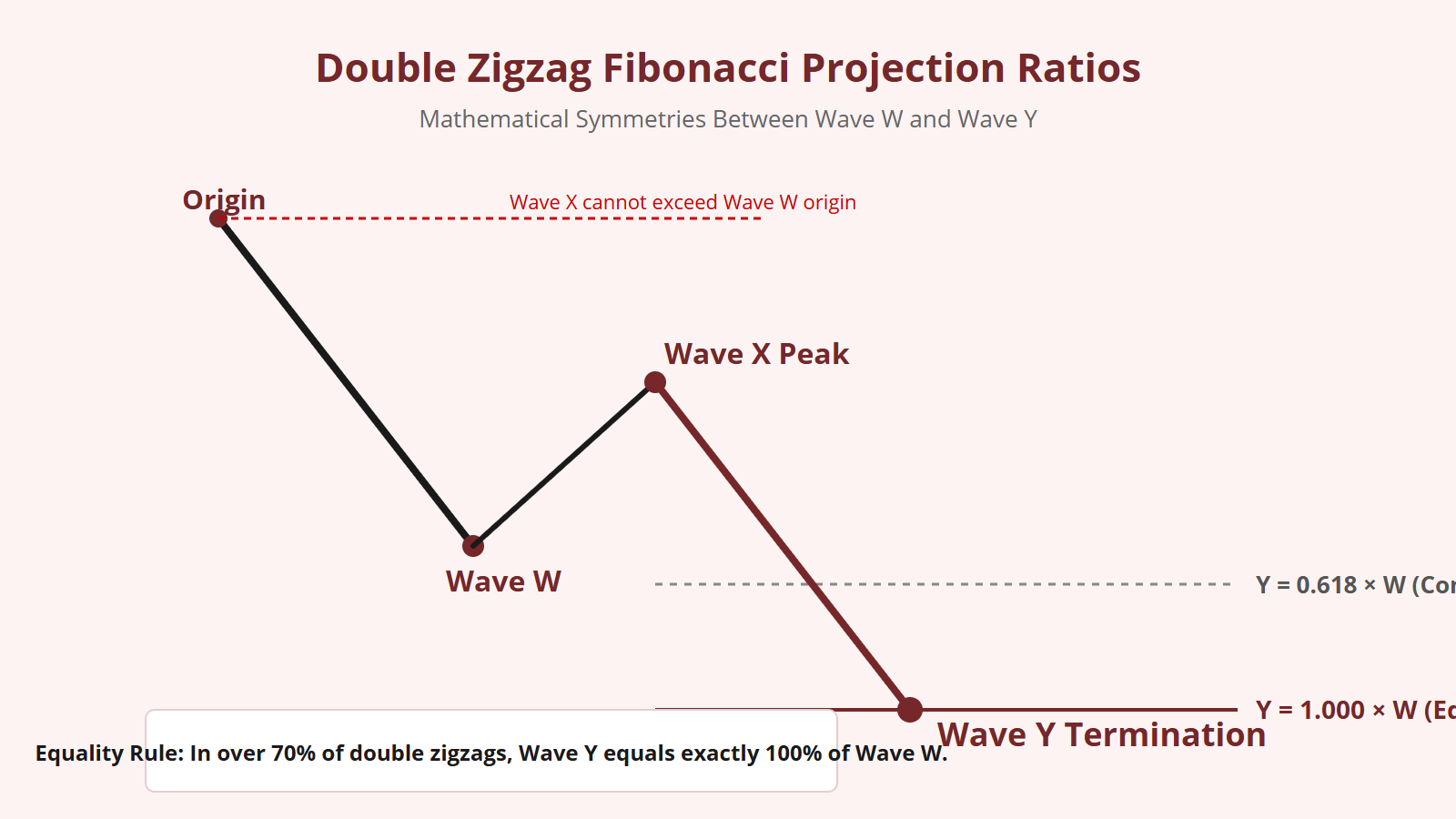
One of the most remarkable properties of the Double Zigzag is its strict adherence to Fibonacci proportionality. In my structural tracking, Wave Y relates mathematically to Wave W in over 85% of verified patterns.
To calculate the terminal target of Wave Y, I measure the absolute vertical distance covered by Wave W and project it from the terminal crest of Wave X:
- The Equality Target ($Y = 1.000 imes W$): In approximately 70% of double zigzags, Wave Y achieves exact mathematical equality with Wave W. When $Y = W$, the pattern exhibits perfect structural symmetry, creating an aesthetically balanced corrective formation.
- The 0.618 Compressed Ratio ($Y = 0.618 imes W$): When underlying trend pressure begins to reassert itself during Wave Y, the secondary zigzag may truncate slightly, completing at precisely 61.8% of the length of Wave W.
- The 1.618 Elongated Ratio ($Y = 1.618 imes W$): In high-volatility liquidations where panic dominates, Wave Y can expand into a devastating extension, reaching 1.618 times the length of Wave W.
When the $Y = 1.000 imes W$ projection intersects a macro Fibonacci retracement level (such as the 61.8% golden pocket of the antecedent impulse), the resulting spatial confluence marks a prime geometric exhaustion zone.
Channeling Techniques for Double Zigzags
Because double zigzags are directional and aggressive, they conform exceptionally well to parallel trend channels. I construct an operational channel using the following geometric method:
- Draw a baseline trendline connecting the terminal low of Wave W and the terminal low of Wave [A] of Wave Y (once established).
- Draw a parallel trendline projected through the extreme peak of Wave X.
This parallel channel contains the entire progression of Wave Y. When sub-wave [C] of Wave Y touches or slightly pierces the lower channel boundary at the exact coordinate where $Y = W$, the Double Zigzag has reached structural fulfillment. A decisive breakout above the upper boundary of this channel provides definitive confirmation that the entire corrective complex has terminated.
Analytical Discipline: Distinguishing Impulses from Double Zigzags
The greatest trap for novice analysts is mislabeling a developing five-wave impulse as a Double Zigzag, or vice versa. Because both structures cover significant vertical distance and feature steep slopes, they can appear superficially similar.
To maintain analytical precision, I verify these distinct structural rules:
- Wave X Subdivisions: An impulse wave has a 5-wave Wave 1 and an impulsive Wave 3. In a double zigzag, the rally between W and Y (Wave X) is strictly a 3-wave corrective structure. If the middle leg exhibits a 5-wave impulse, it is part of an impulse sequence, not a double zigzag.
- Lack of Overlap within Motive Waves: In a true impulse, Wave 4 cannot overlap Wave 1. In a double zigzag, Wave Y routinely overlaps the price territory of Wave W’s sub-waves without violating any rules, because both are corrective legs.
By respecting the mathematical architecture of W-X-Y formations, you gain the clarity to let deep, complex corrections fully unfold before anticipating trend resumption.

Leave a Reply