While the market is governed by complex fractal geometry, it also exhibits a profound tendency toward symmetry. One of the most reliable mathematical guidelines I employ when mapping impulse structures is the Rule of Equality. This rule becomes essential when I am attempting to project the exact termination point of a terminal Wave 5. In a standard five-wave motive sequence, if Wave 3 reaches a massive Fibonacci expansion, I immediately apply the Rule of Equality to anticipate the final geometric leg.
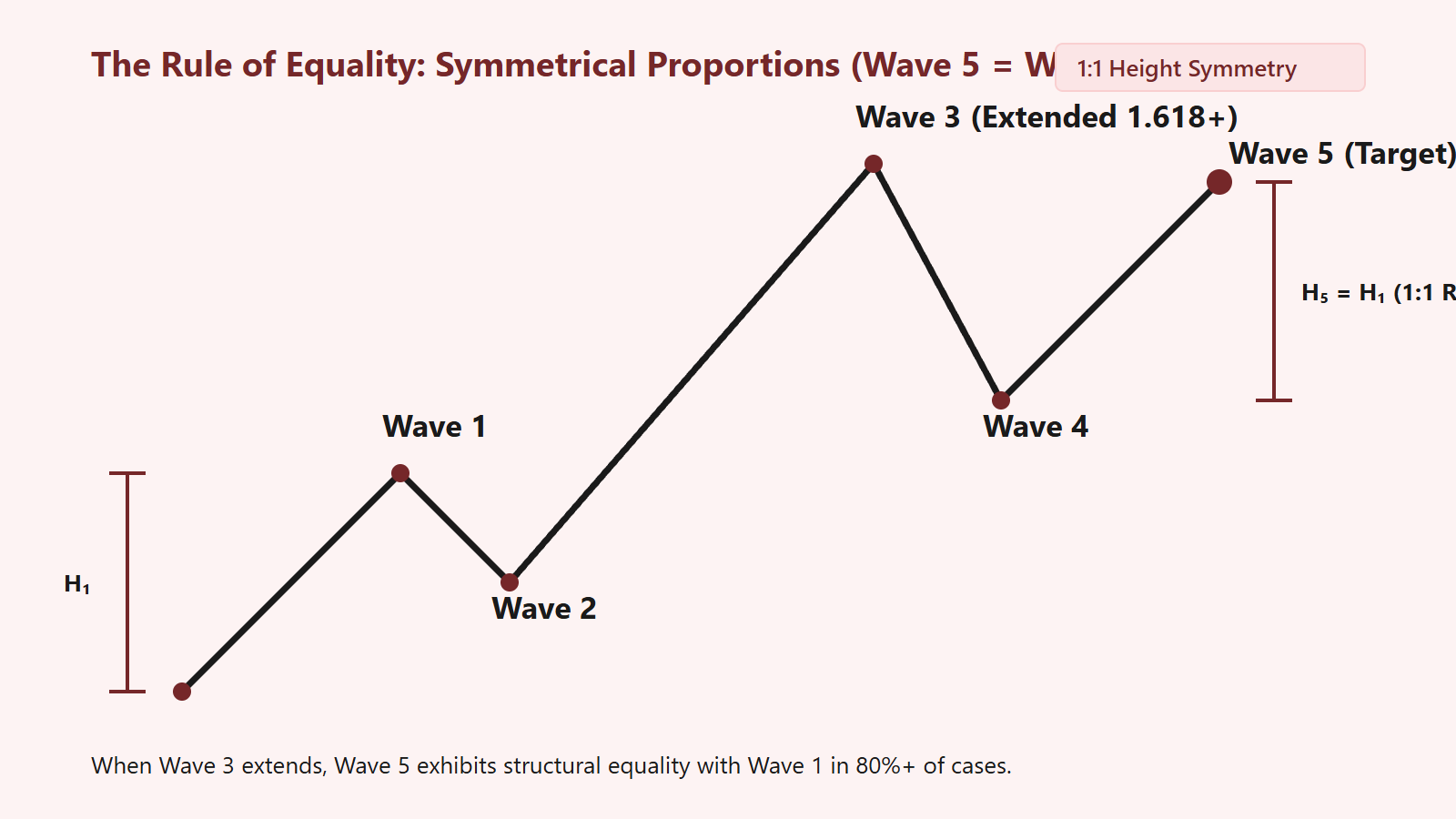
The Structural Foundation of the Rule of Equality
In classical Elliott Wave literature, R.N. Elliott observed a fundamental law of wave mechanics regarding impulse structures: within a standard five-wave motive sequence, one of the three actionary waves (Wave 1, Wave 3, or Wave 5) will extend—meaning it will be significantly elongated and contain distinctly visible internal subdivisions. In the vast majority of market environments, that extended wave is Wave 3.
When Wave 3 extends, it absorbs the lion’s share of directional energy, dynamic volume, and structural expansion. This dynamic creates an intriguing mathematical consequence for the remaining two impulse legs: Wave 1 and Wave 5. Because the system’s expansive capacity was predominantly consumed by the third wave, the market seeks structural balance and equilibrium across the remaining phases.
This is where the Rule of Equality governs the geometry. The rule states: When Wave 3 is the extended wave, Wave 5 will tend toward mathematical equality in price distance with Wave 1, or relate to it through a precise Fibonacci ratio (most commonly 0.618 or 0.382). By applying this guideline, what was once an uncertain terminal thrust transforms into a highly quantifiable geometric projection.
Calculating Wave 5 Projections via Wave 1 Baseline
To apply the Rule of Equality with mathematical rigor, I measure the absolute vertical distance covered by Wave 1, from its structural origin (the zero baseline) to its terminal peak. Once Wave 4 completes its corrective retracement and confirms its low, I project that exact distance upward from the Wave 4 termination coordinate.
The mathematical formulation is direct and unequivocal:
Wave 5 Target (0.618 Ratio) = Termination of Wave 4 + [Length of Wave 1 × 0.618]
Wave 5 Target (1.618 Ratio) = Termination of Wave 4 + [Length of Wave 1 × 1.618]
In my structural case studies, when Wave 3 has expanded to 1.618 or 2.618 of Wave 1, the 1.000 equality relationship between Wave 5 and Wave 1 achieves realization with remarkable frequency. The market mirrors the initial velocity and spatial dimension of the first wave, creating an aesthetically balanced, symmetrical geometric structure before the entire five-wave cycle concludes.
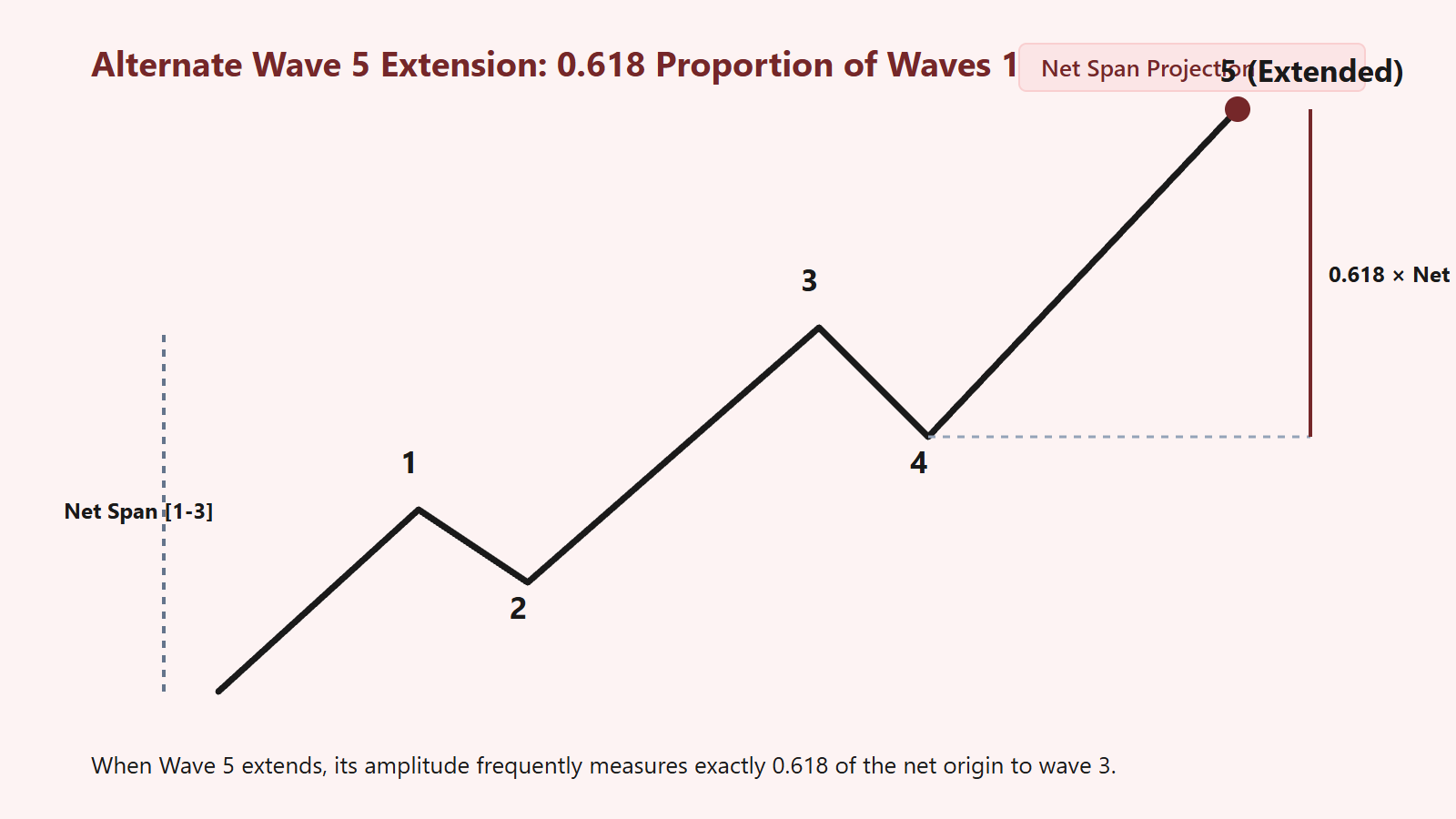
Addressing the 0.618 Compressed Ratio and Wave 5 Extensions
While exact 1.000 equality is the primary benchmark, an analyst must always accommodate market conditions where psychological momentum deviates from standard symmetry. These variations typically manifest in two distinct forms: the compressed fifth wave and the extended fifth wave.
The Compressed 0.618 Relationship: When Wave 3 has been exceptionally violent—expanding to 3.618 or 4.236 times the length of Wave 1—the market’s emotional and structural capital is nearly depleted. In these high-exhaustion environments, Wave 5 frequently lacks the stamina to achieve full equality with Wave 1. Instead, it terminates at exactly 61.8% of the length of Wave 1. I treat the 0.618 projection as the critical minimum structural threshold for Wave 5 validity.
The Extended Wave 5 Scenario: Conversely, in structural environments where Wave 1 and Wave 3 were relatively modest and comparable in length (neither wave being truly extended), the Rule of Equality flips. In this setup, Wave 5 is destined to be the extended wave. When Wave 5 extends, its length is calculated not from Wave 1 alone, but as a Fibonacci proportion of the entire distance from the origin of Wave 1 to the crest of Wave 3. In an extended fifth wave, Wave 5 commonly expands to 0.618 or 1.618 of the net distance traversed by Waves 1 through 3 combined.
Structural Symmetry as an Emotional Antidote
The greatest challenge during a fifth wave is not mathematical; it is psychological. Wave 5 unfolds at the absolute climax of public euphoria (in a bullish impulse) or widespread despair (in a bearish impulse). During a raging fifth wave, news sentiment is overwhelmingly positive, market participants proclaim that prices will rise indefinitely, and conventional analysts discard all risk controls.
This is where the mathematical discipline of the Rule of Equality protects the structural analyst. When everyone around you is convinced the market has entered an unending parabolic surge, you calculate your Wave 5 equality target based on the objective height of Wave 1. When price reaches that precise equality target—and begins to show momentum divergence on the sub-wave degree—you recognize that the cycle has completed its mathematical obligations.
Symmetry removes human hope, greed, and fear from the analytical equation. It reminds me that markets are self-limiting geometric feedback loops. An impulse wave cannot expand indefinitely; it must honor the proportional limits established by its foundational sub-waves.
Step-by-Step Protocol for Projecting Terminal Wave 5
When mapping an active impulse sequence, execute the following protocol to locate the terminal Wave 5 target:
- Verify Wave 3 Extension: Confirm that Wave 3 has satisfied the minimum requirement of extension (measuring at least 1.618 of Wave 1). If Wave 3 did not extend, be prepared for Wave 5 to extend instead.
- Confirm Wave 4 Completion: Do not guess the termination of Wave 4. Wait for Wave 4 to complete its corrective geometry (typically retracing 38.2% of Wave 3) and confirm an impulsive turn higher.
- Calculate the Equality Target: Measure the vertical point distance of Wave 1. Add that exact sum to the verified termination low of Wave 4.
- Calculate the 0.618 Alternate Target: Multiply the length of Wave 1 by 0.618 and add that figure to the Wave 4 low. Mark this as the primary conservative exhaustion level.
- Correlate with Channeling: Draw an Elliott trend channel by connecting the extreme peaks of Wave 1 and Wave 3, and projecting a parallel line through the trough of Wave 2 and Wave 4. Where your Fibonacci Equality level intersects the upper channel line is your prime geometric exhaustion coordinate.
By relying on the Rule of Equality, you replace ambiguity with structural precision. Symmetry is the signature of natural order in financial geometry, and nowhere is that symmetry more evident than in the harmonious balance between the first and fifth waves of an impulse sequence.

Leave a Reply