While the contracting triangle represents a gradual loss of market volatility toward a tight geometric point, the market occasionally exhibits the exact opposite behavioral phenomenon: emotional contagion. When mass psychology loses its structural anchor, price swings do not contract—they expand wildly in both directions, establishing progressively higher highs and lower lows. I classify this volatile geometric structure as the Expanding Triangle. Bound between diverging trendlines that form a megaphone or inverted wedge, an Expanding Triangle is an uncommon but formidable corrective pattern. Mastering its mathematical expansion ratios is the only way to avoid being shredded by its widening volatility swings.
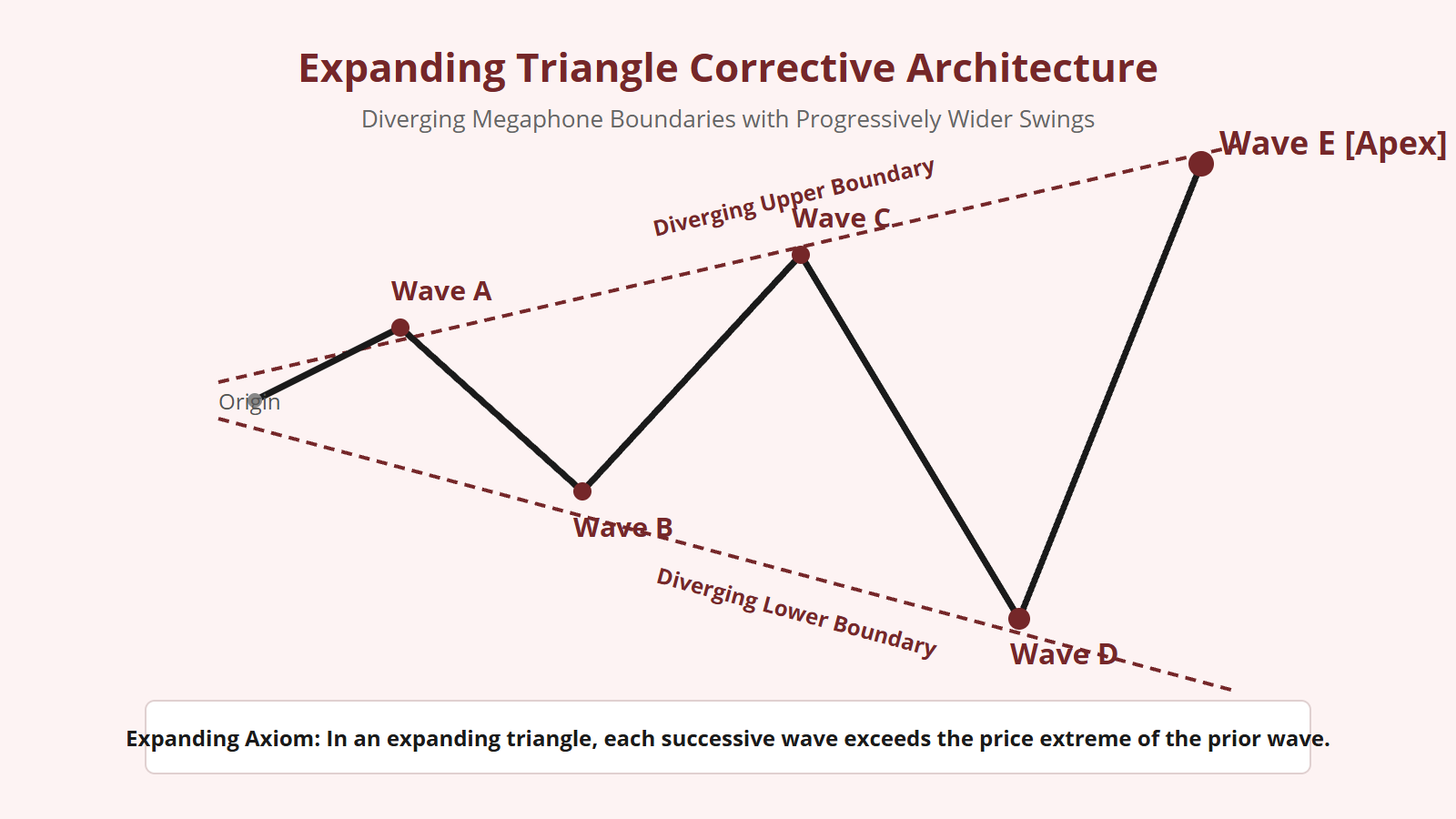
The Psychology of Emotional Contagion
An Expanding Triangle reflects an environment where market participants are completely unhinged by conflicting emotional narratives. In a contracting triangle, participants become cautious, causing volatility to dry up. In an expanding triangle, each successive price swing provokes greater panic, greed, and over-reaction.
The pattern begins modestly, but as price swings develop, participants aggressively chase momentum in both directions:
- Wave A initiates the pattern with a standard 3-wave swing.
- Wave B rallies aggressively, exceeding the origin of Wave A to establish a nominal higher high. Breakout bulls pile into the move.
- Wave C immediately reverses in a violent drop, slicing below the trough of Wave A to print a new lower low, liquidating the bulls.
- Wave D rallies with equal ferocity, punching above the peak of Wave B, trapping early short-sellers.
- Finally, Wave E collapses in a massive liquidation swing, diving deep below the trough of Wave C to trigger maximum capitulation before the entire pattern concludes.
In my structural practice, I view the Expanding Triangle as a giant psychological shredder. It methodically eliminates liquidity from both sides of the market before the true macro trend can resume.
Mathematical Rules: The Diverging 3-3-3-3-3 Structure
Like its contracting counterpart, an Expanding Triangle is governed by the 3-3-3-3-3 internal formula. Every leg within the sequence (A through E) must be a three-wave corrective pattern (a-b-c zigzag, flat, or combination). Impulse waves are strictly forbidden as standalone primary legs.
The defining geometric rules of an Expanding Triangle include:
- Progressive Amplitude Expansion: Each successive wave must exceed the price extreme of the previous wave of the same orientation. Wave B exceeds the origin of Wave A; Wave C exceeds the trough of Wave A; Wave D exceeds the peak of Wave B; Wave E exceeds the trough of Wave C.
- Diverging Boundaries: Connecting the peaks of Wave B and Wave D creates an upward-sloping trendline. Connecting the troughs of Wave A and Wave C creates a downward-sloping trendline. The two lines diverge away from each other as time advances.
- Five Completed Legs: The pattern is not complete until Wave E has fulfilled its 3-wave internal subdivision and established a decisive new low beyond Wave C.
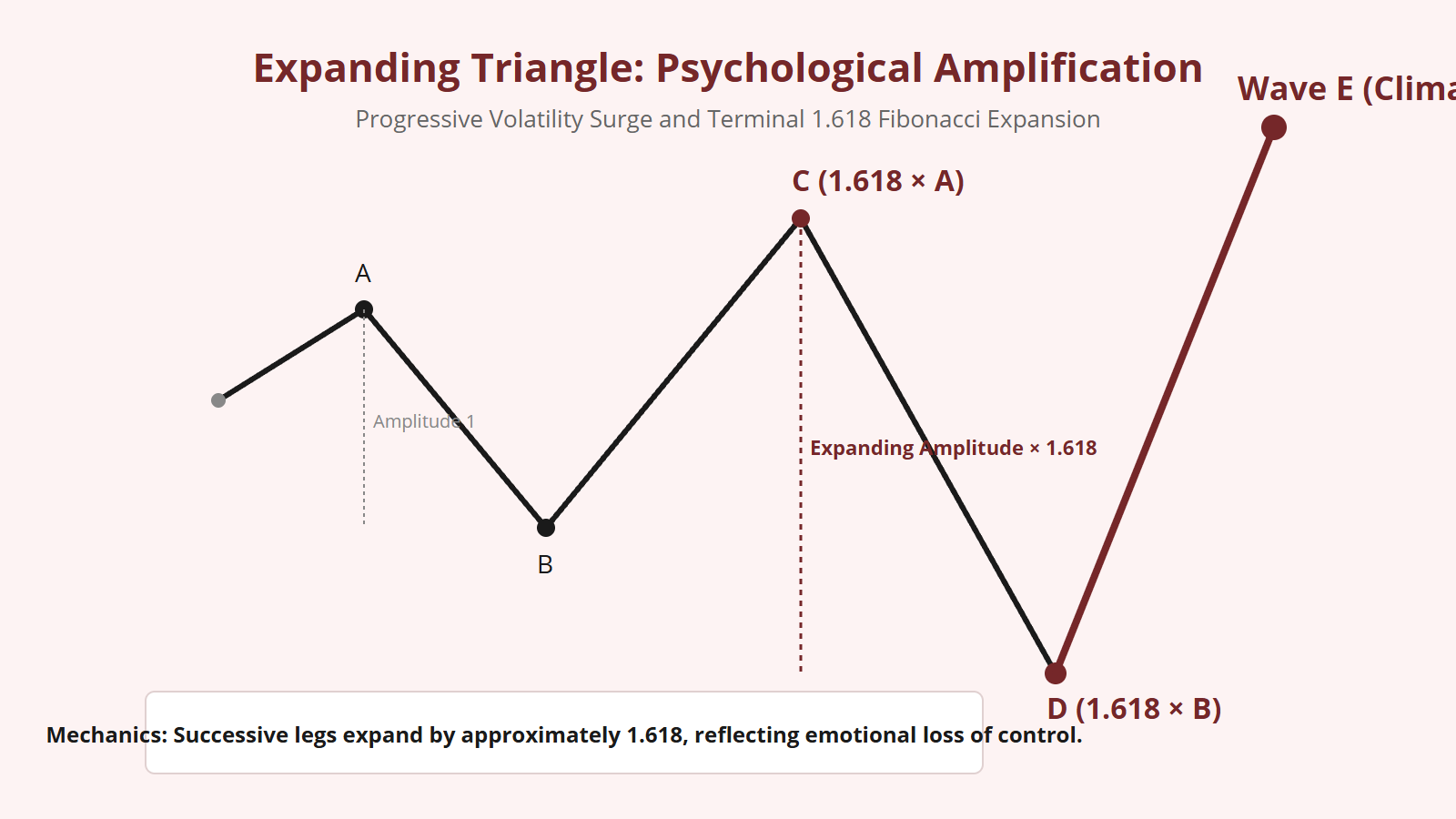
Fibonacci Mathematics: The 1.618 Expansion Ratio
While contracting triangles decay by the 0.618 ratio, Expanding Triangles grow through the inverse Golden Ratio: 1.618. In verified expanding formations, alternating waves consistently expand by approximately 161.8% of the preceding leg:
Wave D Length ≈ Wave B Length × 1.618
Wave E Length ≈ Wave C Length × 1.618
This 1.618 multiplier explains why the swings feel so disorienting to conventional traders: the volatility surge is exponential. By applying these Fibonacci expansion projections, I can calculate the expected terminal boundaries of Wave D and Wave E with mathematical precision, rather than succumbing to emotional panic.
Differentiating Expanding Triangles from Broadening Tops
In classical retail technical analysis, chartists often refer to this geometry as a “broadening top” or “megaphone pattern,” assuming it must always lead to a catastrophic bear market. Under the Elliott Wave Principle, this assumption is fundamentally flawed.
An Expanding Triangle is a corrective pattern, not an automatic trend reversal. If an Expanding Triangle develops in the Wave 4 position of a bull market, it does not forecast a market crash; it simply consumes time and expands volatility before resolving in an explosive upward Wave 5 impulse!
Knowing that the expanding megaphone is merely a complex corrective consolidation allows an Elliottician to remain bullish when the rest of the market believes the world is ending at the bottom of Wave E.
Execution Protocol: Navigating Expanding Volatility
Because an Expanding Triangle features extreme whipsaws, attempting to trade inside the pattern is hazardous. I adhere strictly to this operational framework:
- Stay Sidelined During Swings B, C, and D: Never attempt to guess the pivot point of internal legs when volatility is expanding exponentially.
- Calculate the Wave E Exhaustion Zone: Measure the length of Wave C and project the 1.618 extension downward from the peak of Wave D. Mark this as your high-probability accumulation coordinate.
- Wait for Sub-Wave Completion in E: Verify that internal sub-wave [c] of Wave E has completed its 5-wave motive structure, accompanied by severe momentum divergence on lower timeframe oscillators.
- Enter on the Reversal Breakout: Wait for price to reverse out of the Wave E extreme and print an impulsive micro-wave breaking the prior short-term swing high.
The Expanding Triangle is an extraordinary demonstration of market psychology pushed to its absolute limits. When you understand its 1.618 expansion mathematics, you can view the market’s wildest volatility not as chaos, but as the final coiling of a powerful structural spring.

Leave a Reply