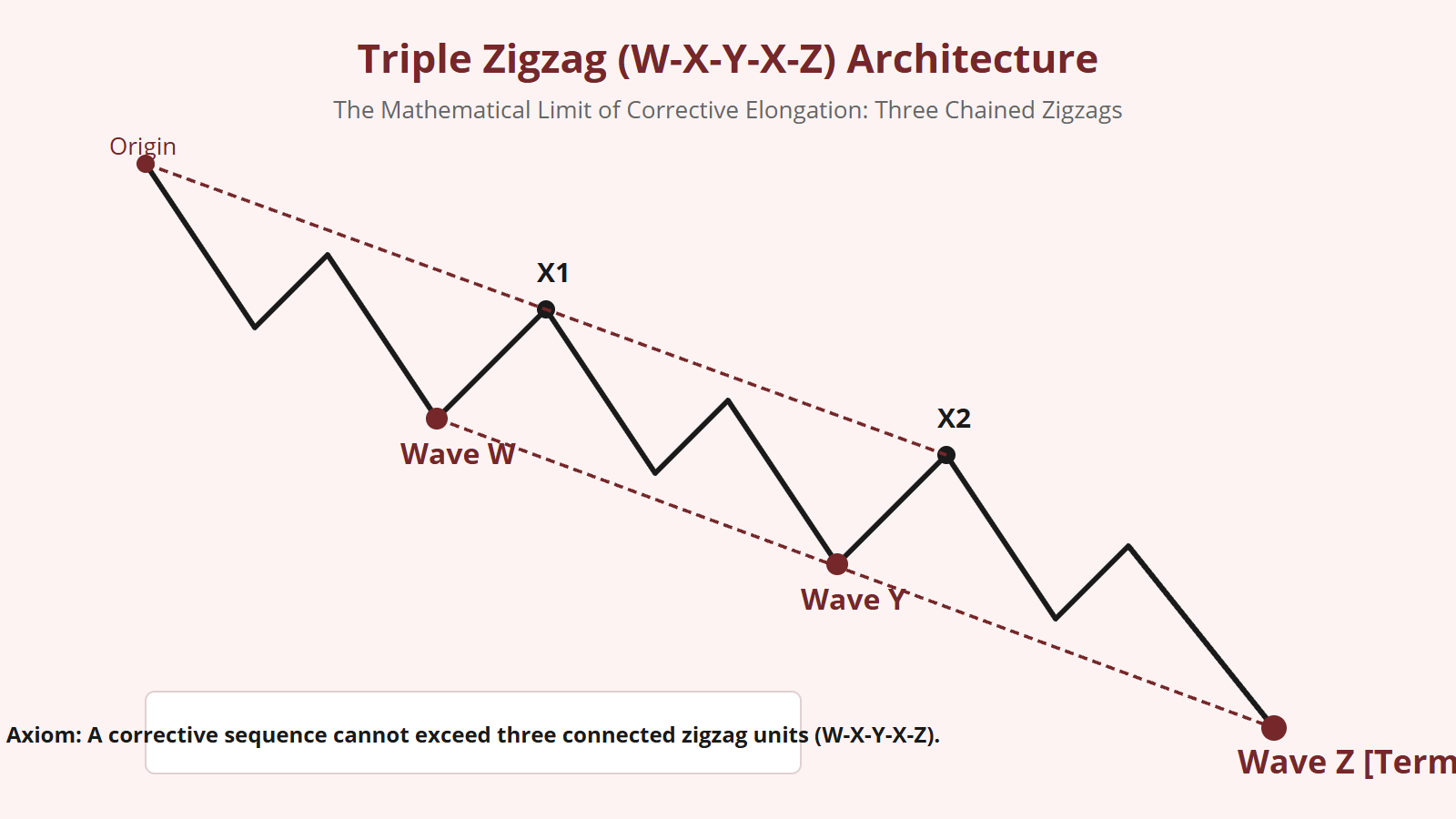
While the market frequently achieves equilibrium through a simple zigzag or a double zigzag, extreme structural imbalances occasionally force price into the absolute mathematical limit of corrective complexity. In these rare, exhaustive environments, the market constructs a Triple Zigzag, labeled W-X-Y-X-Z. A Triple Zigzag represents three consecutive 5-3-5 zigzag formations chained together by two intervening corrective links. In my analytical experience, a Triple Zigzag is a rare phenomenon—a structural storm of relentless corrective pressure that consumes immense vertical territory before exhausting itself in a violent, explosive reversal.
The Structural Limit of Wave Complexity
Under the mathematical laws of the Elliott Wave Principle, structural complexity is finite. An impulse wave cannot contain more than five motive waves (extensions merely create nested five-wave sets), and a corrective combination cannot contain more than three primary corrective units.
A Triple Zigzag is the absolute ceiling of zigzag complexity. Just as Elliott defined the 5-wave impulse as the limit of directional expansion, he established that a market cannot chain four zigzags together. The sequence terminates at Wave Z. When I identify a market developing its third consecutive zigzag leg inside a multi-month decline, I know that the structural system is expending its final kinetic reserves.
Triple Zigzags occur primarily in two environments: during severe cyclical bear corrections following a massive speculative blow-off, or within prolonged Wave 2 pullbacks where the market completely wipes out early aggressive participants before the true trend begins.
Anatomy of the W-X-Y-X-Z Sequence
A Triple Zigzag consists of five primary structural components, alternating between directional zigzags and counter-trend connectors:
- Wave W: The initial 5-3-5 Zigzag. It breaks the prior trend channel and establishes the preliminary corrective trajectory.
- Wave X1: The first connective bridge (3-wave structure). It retraces a portion of Wave W, offering brief structural consolidation.
- Wave Y: The secondary 5-3-5 Zigzag. It breaks below the trough of Wave W and drives price into deeper Fibonacci retracement zones.
- Wave X2: The second connective bridge (3-wave structure). Crucially, Wave X2 rarely retraces as deeply as Wave X1. It is typically shallow, compressed, and brief, reflecting market exhaustion and a desire to resolve the correction.
- Wave Z: The final 5-3-5 Zigzag. Wave Z represents the terminal thrust. It pushes to a nominal new low below Wave Y, completing the final five-wave sub-leg of sub-wave [C] of Z.
The complete internal notation for a Triple Zigzag is: (5-3-5) + 3 + (5-3-5) + 3 + (5-3-5). It contains eleven distinct sub-waves across intermediate degrees, all functioning as a single macro corrective entity.
Fibonacci Proportionality Across Three Legs
Managing the Fibonacci relationships across three consecutive zigzag legs requires meticulous mathematical tracking. In a standard Triple Zigzag, the three actionary legs (W, Y, and Z) tend toward harmonious geometric proportions:
- Equality Progression ($W = Y = Z$): In ideal symmetrical conditions, each zigzag covers approximately the same vertical point distance. If Wave W measures 200 points, Wave Y will measure 200 points from X1, and Wave Z will measure 200 points from X2.
- Diminishing Proportions ($Z = 0.618 imes Y$): In many instances, the third leg shows signs of kinetic fatigue. Wave Z will frequently terminate at exactly 61.8% of the distance covered by Wave Y, creating a structural compression that signals the end of corrective momentum.
- Total Distance Projections: The entire span from Origin 0 to the terminus of Wave Z frequently fulfills a major macro Fibonacci retracement (such as 78.6% or 88.6%) of the antecedent impulse cycle.
Channeling and the Terminal Signature of Wave Z
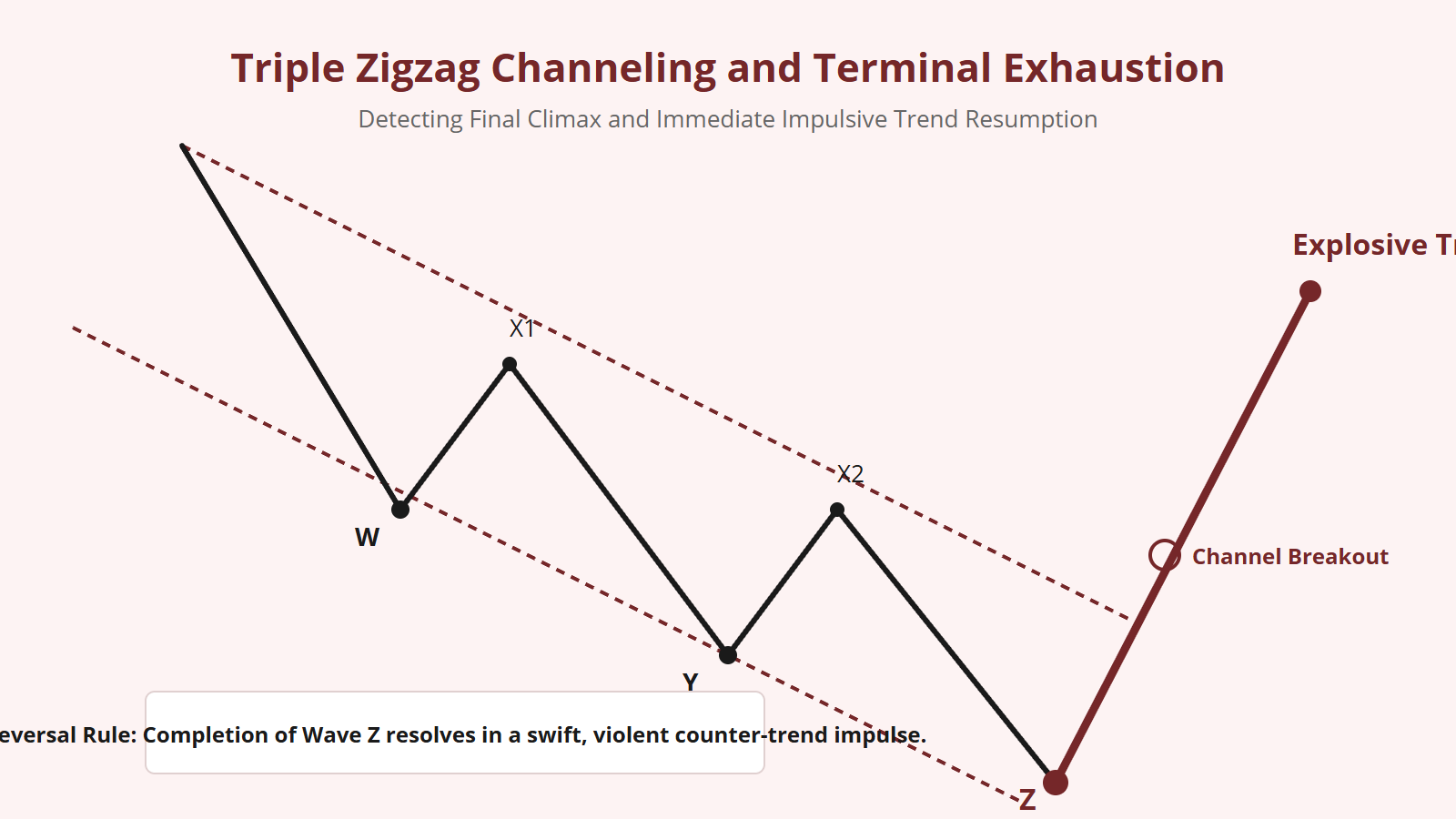
Like the Double Zigzag, a Triple Zigzag adheres strictly to a narrow, steep trend channel. To track the terminal boundary of Wave Z:
- Connect the peak of Wave X1 and the peak of Wave X2 with a clean trendline.
- Project a parallel trendline through the trough of Wave W and Wave Y.
Wave Z will systematically drive toward the lower boundary line of this channel. In many terminal setups, Wave Z exhibits a micro ending diagonal within its internal sub-wave [C], accompanied by severe positive momentum divergence across multiple timeframe oscillators.
When price touches the lower channel line and momentum indicators register extreme divergence, the market reaches what I call the Structural Rubber-Band Effect. The corrective energy has been stretched to its absolute mathematical limit.
The Explosive Resolution: The Post-Z Impulse
Because a Triple Zigzag consumes so much directional energy and pushes market sentiment into historic extremes of despair or complacency, the subsequent market reaction is universally explosive.
Once Wave Z terminates, the market does not slowly drift sideways. It initiates a violent, parabolic impulse wave in the opposite direction. Within a few sessions, this new motive wave tears through the X1 and X2 trendlines, invalidating the entire corrective channel and confirming that the macro trend has resumed.
Recognizing a Triple Zigzag in its terminal stages is one of the most rewarding analytical achievements in Elliott Wave theory: it allows you to identify the absolute floor of a multi-month liquidation right at the point of maximum public panic.

Leave a Reply