When a market completes the five contracting sub-waves of a triangle, the stored geometric tension does not simply dissipate. It discharges into an explosive, high-velocity move known as the Post-Triangle Thrust. In the Elliott Wave Principle, this thrust is not an arbitrary swing; it is a mathematically quantifiable vector with precise distance objectives and profound structural implications. In my analytical practice, calculating the post-triangle thrust measurement is one of the most reliable forecasting tools available. By measuring the base width of the triangle and projecting it from the Wave E pivot, an analyst can anticipate the exact price coordinate where the final wave of the trend will reach mathematical exhaustion.
The Mechanics of the Post-Triangle Release
During the formation of a triangle, the market enters a state of artificial compression. Volatility contracts, liquidity dries up, and participants become paralyzed by the narrowing price swings. However, behind this outward stillness, immense directional pressure is accumulating.
When Wave E terminates, the compression ends. Price breaks decisively out of the converging boundary trendlines in the direction of the dominant macro trend. This release of stored kinetic energy is termed the Thrust.
The post-triangle thrust is characterized by distinct behavioral traits:
- It moves with exceptional velocity, often printing wide-range price bars with minimal counter-trend pullbacks.
- Volume surges dramatically as price crosses the boundary trendlines.
- It covers price distance rapidly, driving directly toward its mathematically budgeted objective.
However, the thrust is not the beginning of a new multi-year trend; it is the final act of an aging structural cycle.
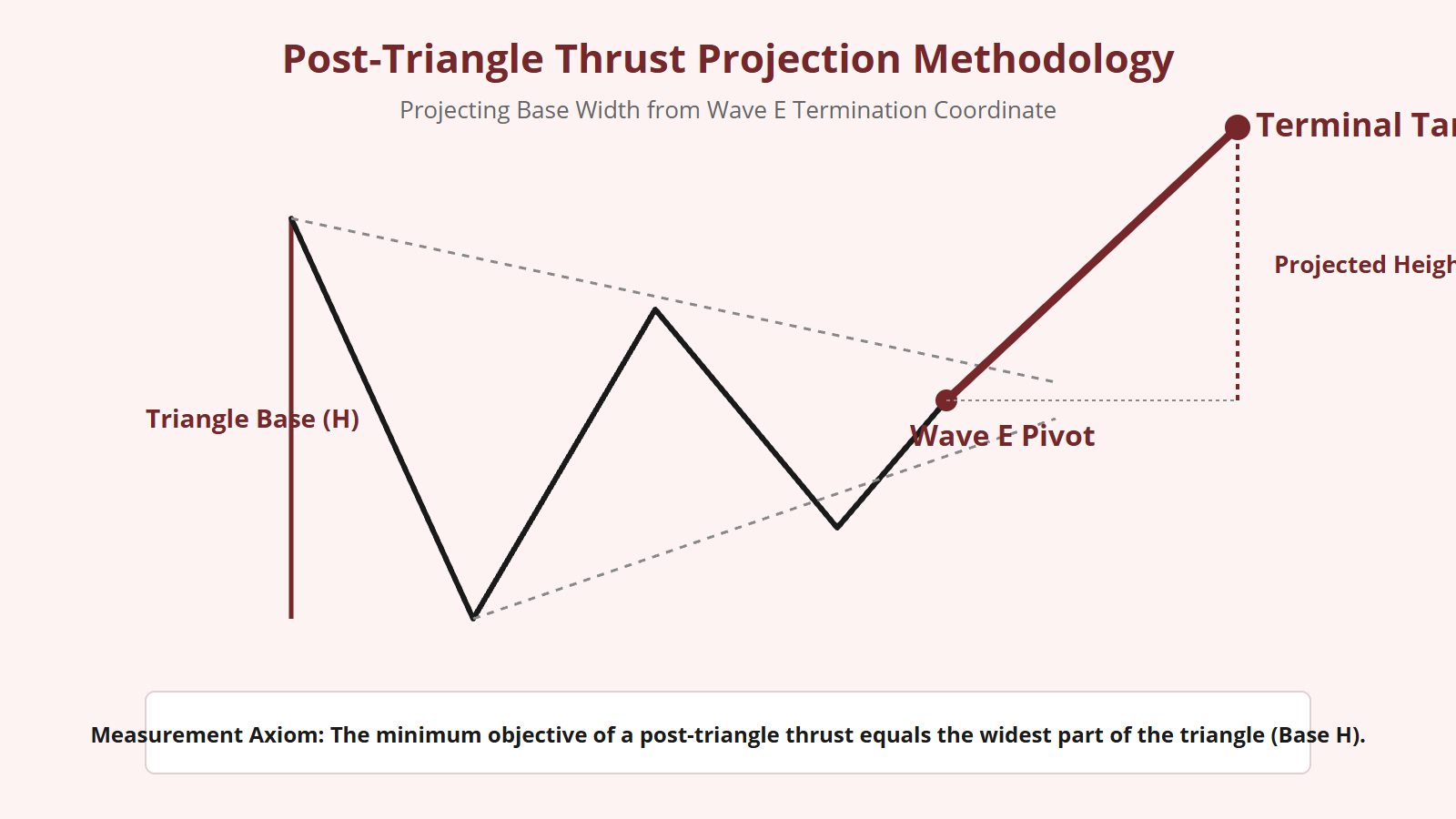
The Mathematical Formula for Thrust Projections
R.N. Elliott established a precise geometric guideline for measuring the minimum and typical price objective of a post-triangle thrust:
2. Standard Thrust Objective = Wave E Pivot + Base Height (H)
3. Maximum Extended Objective = Wave E Pivot + (Base Height × 1.618)
Let us illustrate with a quantitative example: If a contracting triangle develops in Wave 4 with its base (Wave A) measuring 150 points from peak to trough, the base height ($H$) is 150 points. If Wave E completes its corrective pivot at 4,200, the primary thrust objective for Wave 5 is:
$$ ext{Wave 5 Target} = 4,200 + 150 = 4,350$$
In over 75% of verified triangle formations, the post-triangle thrust fulfills this 1.000 base projection with pinpoint accuracy, halting within a few ticks of the calculated coordinate before initiating a major trend reversal.
The Penultimate Rule: Why the Thrust is Terminal
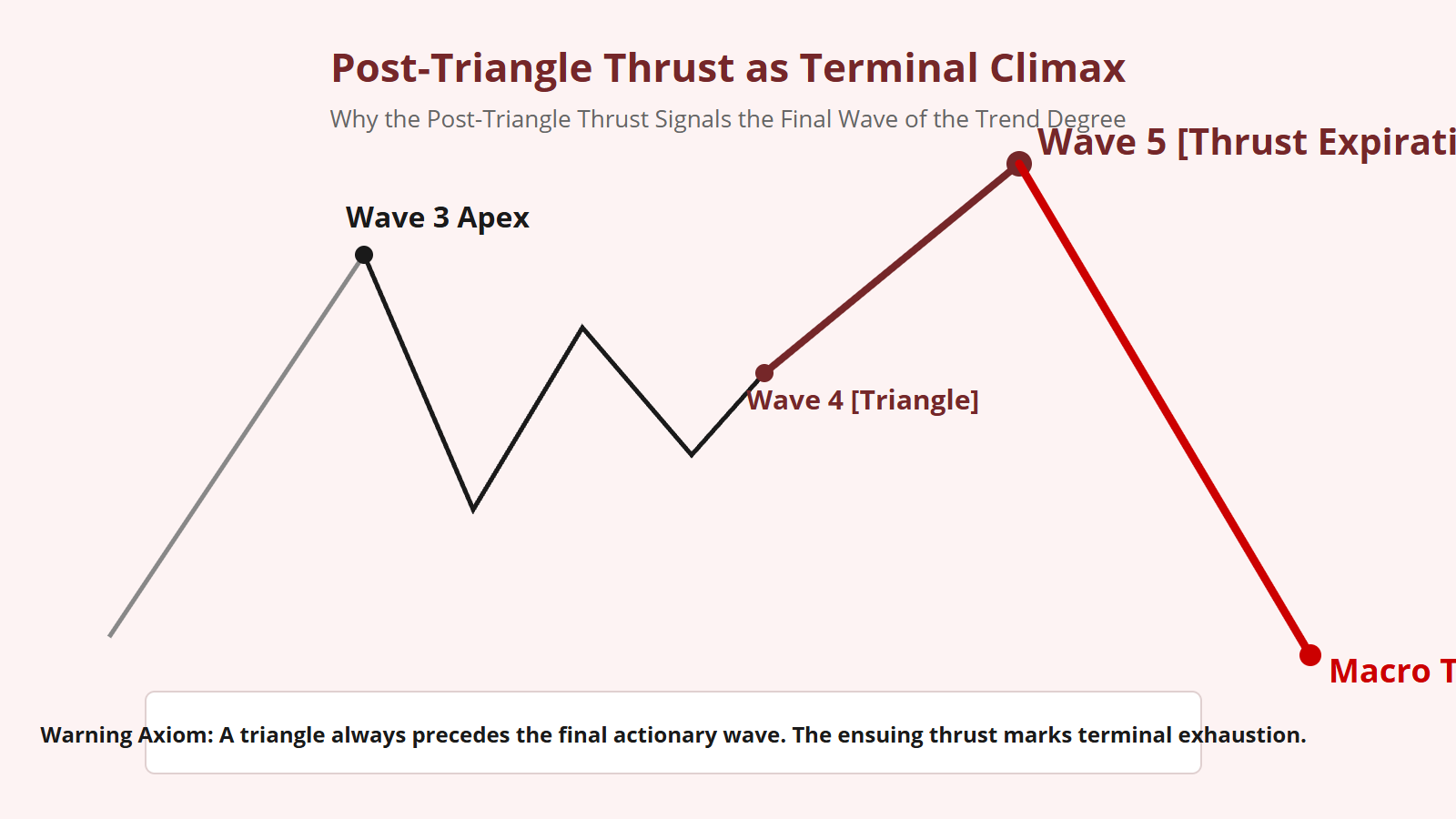
The most vital structural rule an analyst must remember when evaluating a post-triangle thrust is the Rule of Penultimate Placement:
A triangle always occurs in the position prior to the final actionary wave of a larger degree pattern.
This means that whenever you observe a post-triangle thrust, you are observing the final wave of that degree:
- If the triangle formed in Wave 4, the ensuing thrust is Wave 5—the final wave of the entire five-wave impulse sequence!
- If the triangle formed in Wave B, the ensuing thrust is Wave C—the final wave of the entire corrective structure!
- If the triangle formed in Wave X, the ensuing thrust is Wave Y or Z—the terminal leg of the complex combination!
This insight completely alters your strategic mindset. While breakout traders view the violent post-triangle surge as an invitation to buy and hold for the long term, an Elliottician recognizes that the thrust is the final dying gasp of the trend. When the thrust target ($H$) is reached, the entire multi-wave cycle terminates, setting the stage for a massive counter-trend reversal.
Divergence and Exhaustion at the Thrust Apex
Because the post-triangle thrust is a terminal wave, it exhibits unmistakable geometric symptoms of exhaustion as it nears its target projection:
- Momentum Oscillator Divergence: While price pushes to a new extreme during the thrust, momentum indicators (such as RSI or MACD) register a lower peak compared to Wave 3 of the sequence. This severe divergence confirms that underlying structural stamina is depleted.
- Subdivision Completion: The thrust must subdivide cleanly into five micro-waves [i]-[ii]-[iii]-[iv]-[v]. When sub-wave [v] of the thrust reaches the calculated base height ($H$), the pattern is complete.
- Ending Diagonal Variant: In many terminal setups, the post-triangle thrust unfolds as an Ending Diagonal (3-3-3-3-3), providing the ultimate confirmation of imminent structural collapse.
The Violent Origin Retracement Following the Thrust
Once the post-triangle thrust fulfills its mathematical target and terminates, the market experiences an abrupt and severe reaction known as the Origin Retracement.
Because the triangle consumed so much time and volatility, its boundary lines represent a massive liquidity void. When the post-thrust trend reversal begins, price collapses back into the price territory of the triangle with extraordinary speed. In almost all instances, the subsequent correction completely retraces the entire post-triangle thrust, returning price directly to the baseline level where Wave E began.
By calculating the post-triangle thrust measurement in advance, you achieve total mastery over the final phase of a trend: you capture the explosive final extension, exit at the mathematical target, and prepare for the violent reversal that follows.

Leave a Reply