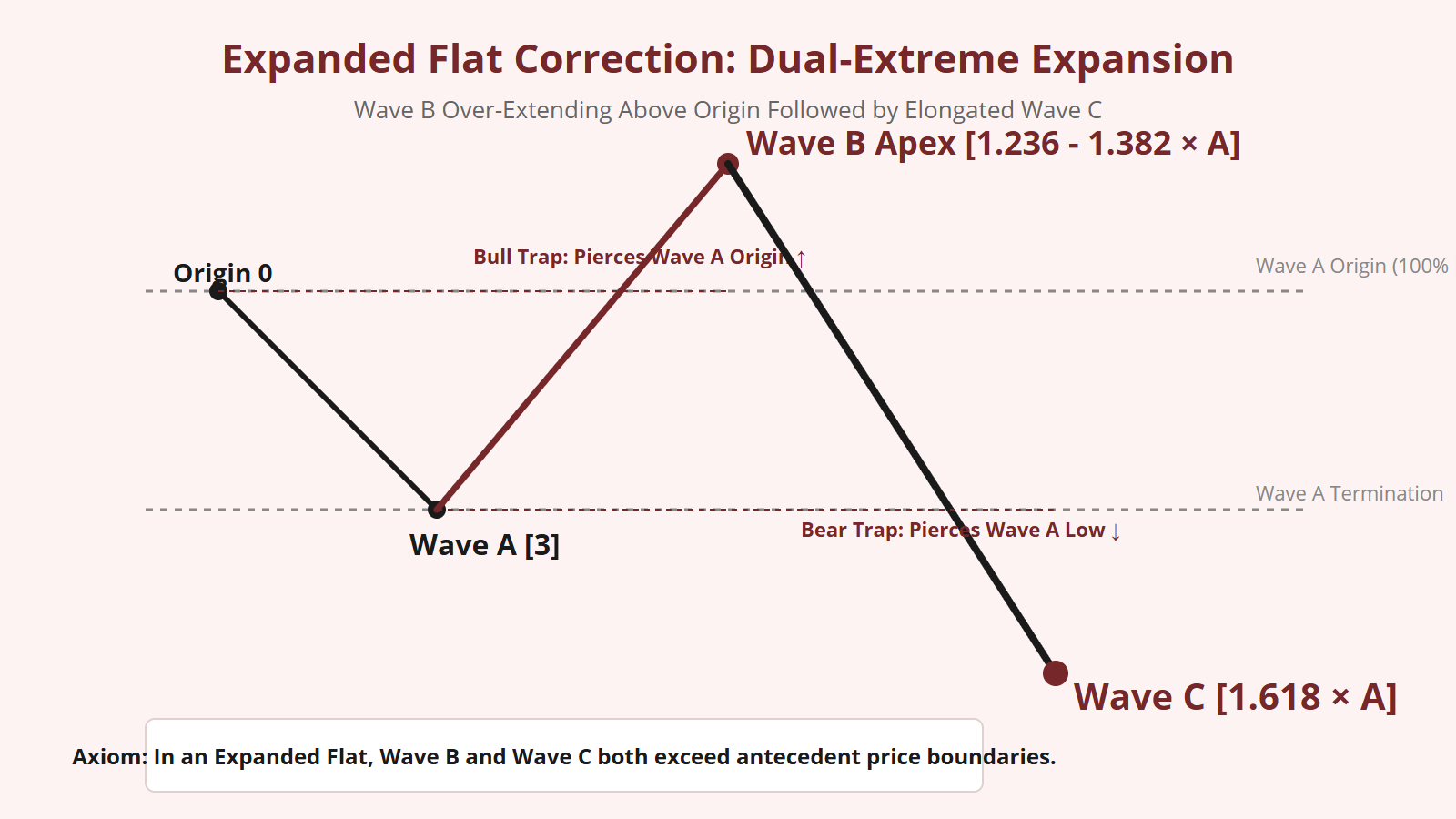
Of all the corrective patterns in market geometry, none is more psychologically devastating or widely misunderstood than the Expanded Flat. While a regular flat remains comfortably contained within horizontal parallel boundaries, an Expanded Flat shatters boundaries in both directions. In an Expanded Flat, Wave B aggressively pushes beyond the starting point of Wave A, creating a deceptive false breakout, only for Wave C to reverse violently and plunge far past the extreme of Wave A. I classify this structure as the ultimate liquidity trap of market mechanics. Understanding the exact Fibonacci extension ratios of an Expanded Flat is the only way to avoid being whipsawed by its dual-extreme expansion.
The Psychology of the Dual Liquidity Sweep
The Expanded Flat is the most common variety of flat correction in modern financial charts. It occurs in environments of high volatility where market participants are eager to jump on directional momentum prematurely.
The psychological progression unfolds in two destructive phases:
- The Bull Trap (Wave B): After Wave A completes a modest pullback, Wave B rallies with immense speed. It slices through the previous trend high (the origin of Wave A). Retail participants assume the macro trend has resumed, buying aggressively into the breakout. In reality, Wave B is merely a 3-wave corrective leg (a-b-c) that has over-extended.
- The Bear Trap (Wave C): As soon as the breakout buyers commit their capital, buying pressure evaporates. Wave C unleashes a devastating five-wave impulse decline. It plunges through the Wave B high, slices through the Wave A origin, and drives deep below the Wave A trough, triggering stop-losses across the board and trapping early buyers.
By expanding beyond both the upper and lower extremes of the preceding structure, the Expanded Flat completely clears the order book of weak participants before the true trend resumes.
Mathematical Specifications of the Expanded Flat
Despite its volatile appearance, the Expanded Flat is governed by rigorous mathematical proportions. Like all flats, its internal subdivision is strictly 3-3-5, but its spatial dimensions diverge sharply from the regular flat:
- Wave A (3 Waves): Unfolds as an a-b-c corrective structure, establishing the initial baseline distance.
- Wave B (3 Waves): Wave B must decisively exceed the price origin of Wave A. Mathematically, Wave B typically terminates between 1.236 and 1.382 times the length of Wave A:
$$ ext{Wave B Target} = ext{Origin of A} + ( ext{Length of A} imes 0.236 ext{ to }0.382)$$
In rare high-volatility environments, Wave B can reach the 1.618 extension of Wave A. - Wave C (5 Waves): Wave C is a powerful 5-wave motive impulse ([i]-[ii]-[iii]-[iv]-[v]). It must decisively break below the terminal low of Wave A. In over 80% of expanded flats, Wave C measures 1.618 times the length of Wave A:
$$ ext{Wave C Length} = ext{Length of Wave A} imes 1.618$$
Occasionally, Wave C expands to 2.618 times Wave A in extreme liquidation cascades.
Diverging Trendline Geometry
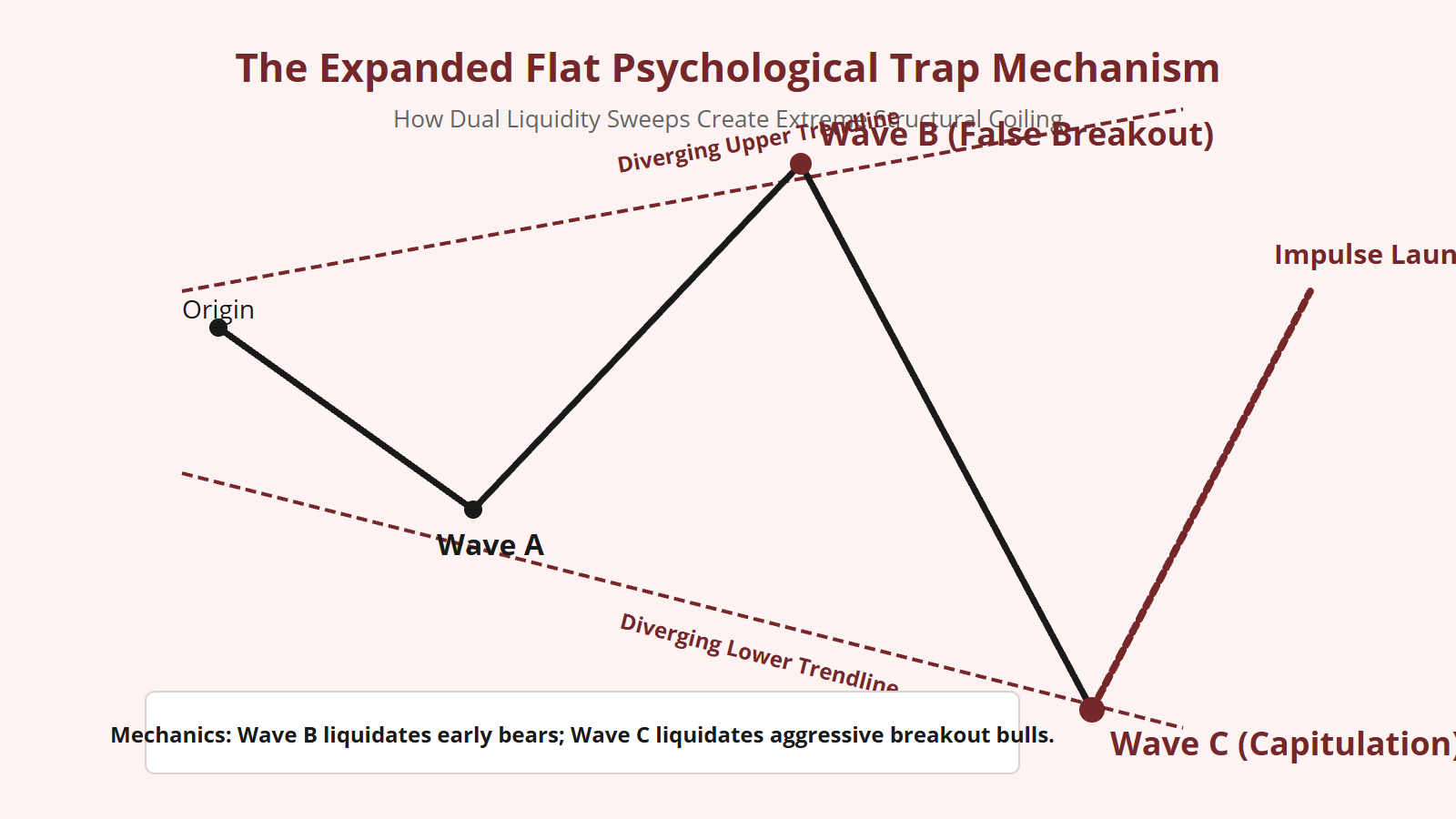
While a regular flat forms a rectangle, an Expanded Flat forms a diverging megaphone or expanding horn. When I map an active Expanded Flat:
- I draw an upper trendline connecting the origin of Wave A to the peak of Wave B.
- I draw a lower trendline connecting the trough of Wave A to the anticipated terminus of Wave C.
These boundary lines diverge away from each other as the pattern matures, visually representing the expanding amplitude of market volatility. When price reaches the lower diverging boundary line at the exact coordinate where Wave C fulfills its 1.618 extension relative to Wave A, the pattern achieves geometric resolution.
Verifying Wave C Internal Motive Mechanics
Because Wave C in an Expanded Flat is an impulse wave, an analyst must apply all the Cardinal Laws of motive mechanics to verify its completion. During the panic of Wave C, participants believe the market is collapsing into an unending bear market. As a wave expert, I calmly monitor the internal subdivisions:
- Verify that sub-wave [iii] of Wave C exhibits strong momentum and is not the shortest wave.
- Verify that sub-wave [iv] of Wave C does not overlap sub-wave [i].
- Monitor sub-wave [v] of Wave C for momentum divergence against sub-wave [iii].
When sub-wave [v] of Wave C completes its five micro-legs below the Wave A low, the selling panic abruptly terminates. The liquidity sweep is complete, and the stage is set for an explosive reversal.
Strategic Guidelines for Navigating Expanded Flats
To avoid falling into the psychological traps inherent in Expanded Flats, I adhere strictly to these analytical rules:
- Never Buy a Breakout in Wave B: If an advance off a corrective low subdivides into three waves (a-b-c) rather than five, never trust a new high. A 3-wave breakout is the classic signature of an over-extended Wave B.
- Calculate the 1.618 Extension in Advance: Once Wave B peaks, immediately calculate the 1.618 projection for Wave C. Mark this coordinate on your chart as your primary accumulation zone.
- Wait for the Reversal Impulse: Do not attempt to catch the falling knife in the middle of Wave C. Wait for the five sub-waves of C to complete, and look for a nascent 5-wave micro-impulse in the primary trend direction to confirm that the Expanded Flat is officially closed.
The Expanded Flat is an extraordinary demonstration of market geometry: what appears to the untrained observer as violent chaos is, in truth, a flawlessly orchestrated Fibonacci liquidity cascade.

Leave a Reply